
Basic and Applied Ecology 97, 151865, https://doi.org/10.1016/j.baae.2026.151865
Involved members of MultiTroph: Massimo Martini, Matteo Dadda, Felix Fornoff, Heike Feldhaar, Arong Luo, Finn Rehling, Joshua E. Spitz, Michael Staab, Simon Thorn, Chao-Dong Zhu, Alexandra-Maria Klein
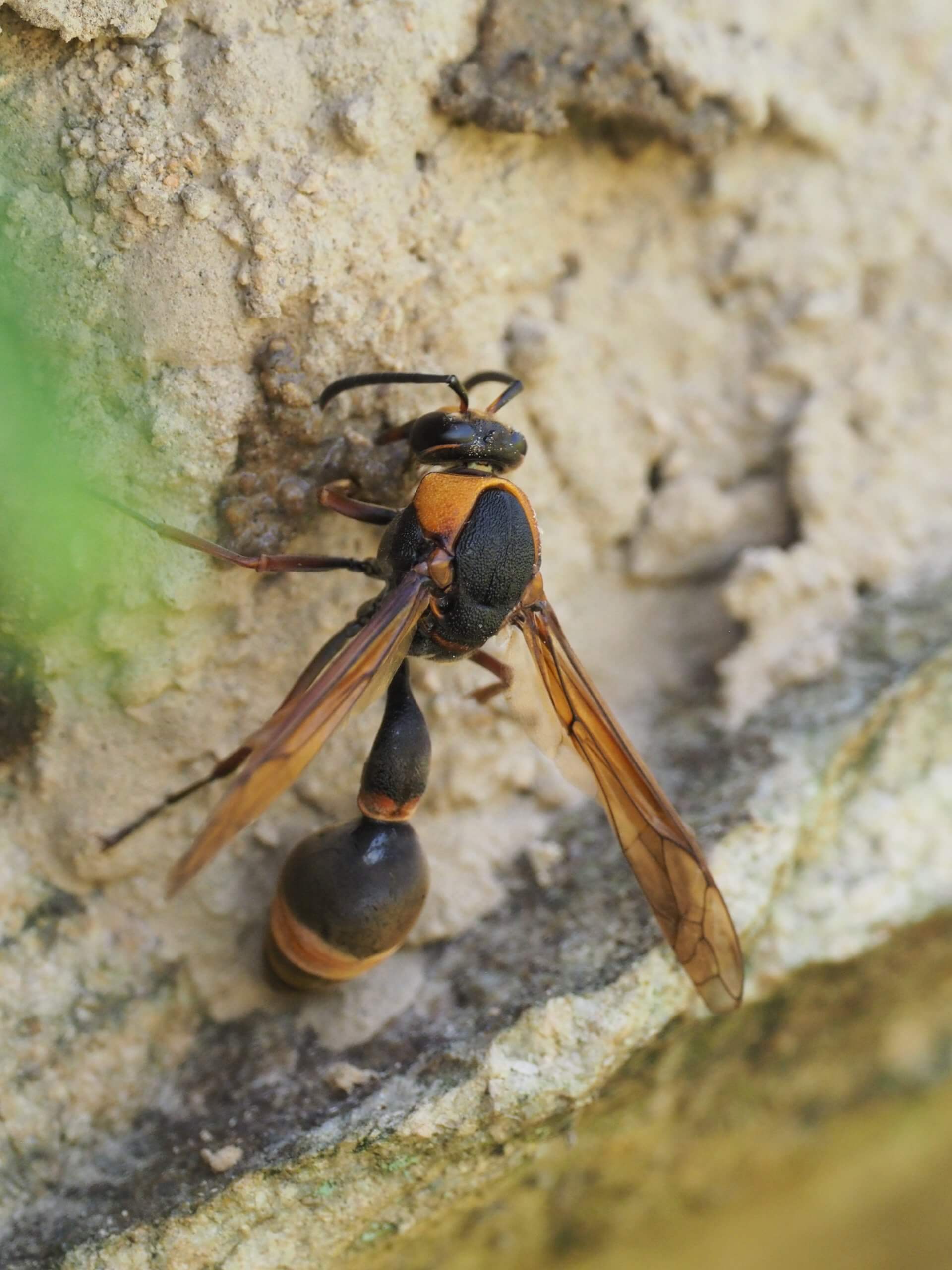
Summary: The study investigates how deadwood characteristics and environmental conditions influence communities of cavity-nesting bees, wasps, and their parasitoids at the BEF-China site. The researchers examined the effects of tree diversity, deadwood position (lying or standing), and ant activity on insect communities. The results show that standing deadwood supported higher diversity of cavity-nesting Hymenoptera than lying deadwood. Moisture was identified as an important limiting factor for nesting communities, whereas ant activity had no observable effect.
Conclusion: Standing deadwood appears to provide more suitable nesting habitats for cavity-nesting bees, wasps, and parasitoids than lying deadwood. Therefore, retaining standing deadwood in managed forests could be an effective conservation strategy to support these insects.